Showing posts with label Borrowing referendum. Show all posts

Friday, October 17, 2014

Wednesday, October 8, 2014

More concerns about cost estimates.

Taxpayers who attended the public meeting(s) are familiar with the presentation by staff that begins with Walkerton and continues with the fret of pending water born disease outbreaks. That softens up the audience for the next segment provided by the consultant who goes through a number of slides to demonstrate that proposed option is the most cost effective option. Here is the slide in question:


Option 2 is the favoured option of the consultants and staff.

Note that Option 6, the most desirable option for long term efficacy, is depicted as the most expensive and least desirable option. The slide below is a closer examination of Option 6.


Observe that the total cost is listed at $182.8 million. However, that includes a filtration plant in 2042. I am reasonably sure that many of the current customers will not worry about that cost by 2042. Removing that sum will leave a cost of $132 million, a price tag much more attractive.

Consider deferring Okanagan Lake intake, costing $34.7 million, until 2030. The price tag will drop to $98.1 million, a much more comparable cost.

Additionally, the system separation and irrigation transmission main costs should also be evaluated for accuracy. The initial cost estimate for total separation was $35 million and we have completed about $12 million worth of those projects. It is highly unlikely that separation costs increased from $23 million ($35-12=$23) unless the original estimates were guesses. If they were inaccurate then the new estimates could be also highly unreliable as the same financial expert was making both estimates.

It is easy to rush through a presentation to customers unfamiliar with the projects and unsure what questions to ask. This is why it is important to re-evaluate the MWP by an independent group of experts who will then consider other viable and more cost effective plans.

******************************************************************

Public open house for water referendum


Last night's (October 7th) water referendum open house was the most successful yet. According to the organizers a total of 32 members of the public participated in the meeting.

Unfortunately, the tune of the message did not change despite the previous comment by the IH representative regarding the consequence of a "NO" vote. The fret of potential action by IH was front and center. In fact, the IH official stated previously that if the referendum failed the participants would have to get together and examine alternative actions. That does not sound like a fret.

RDNO representative Director McNabb (who is not on the water system and will not be affected by the outcome) stated that "... we are all in it together..". Not true, some of us will have to pay! He also stated that we cannot use taxation for paying for the loan because not all taxpayers would benefit from the infrastructure. He neglected to mention that those taxpayers will not be able to vote and they will not have to pay the taxes either. Check out the voting eligibility map.

As the only political representative on the Technical Advisory Committee I was hoping to have a few words to the attendees but, for the most part, my efforts to speak were ignored.

The next public presentation will be at the RDNO office on October 28, 2014.

************************************************************************

Tuesday, October 7, 2014

Water Open House

Water from tap 1Greater Vernon Water users are reminded there is another open house today on the 70 million dollar borrowing referendum for system improvements.

This one is at the Rec Centre from 5 til 7.

******************************************************************

Tuesday, September 30, 2014

Water Referendum Open House in Coldstream last night


Last night's presentation of the need for the $70 million referendum did not fetch any more interest than did the presentation at the Schubert Centre. For comparison I included photos of both attendance.

One thing I found quite interesting. When questioned about what would happen if the referendum failed, Interior Health representative stated that we would have to go back to the drawing board and see how the plan could be improved. That was exactly what some of the GVAC representatives promoted before the North Okanagan Regional District's Board of Directors approved the current plan.

******************************************************************************

Monday, September 29, 2014

Before you go to tonight's water referendum meeting take a look at this


 ***********************************************************************************


For examples compare costs for users of 50, 100 and 150 cubic meters per quarter:

Greater Vernon:
                    50------$154.30
                  100------$242.30
                  150------$349.80

Kelowna: (quarterly costs)
                    50------$  55.63

                  100------$  81.36
                  150------$108.54

***********************************************************************

Water Referendum Open House in Coldstream tonight!


To provide information on the Greater Vernon Water Borrowing Referendum and the Master Water Plan priority projects, four open house sessions will be offered beginning in September. Please join RDNO staff at one of the following sessions:

OPEN HOUSE SESSION

SEPTEMBER 29  5:00PM TO 7:00PM WOMEN'S INSTITUTE HALL,
COLDSTREAM


The GVW open house begins at 5:00 p.m. with a presentation at 5:30 p.m., and a question and answer session to close the evening.

*****************************************************************

Wednesday, September 24, 2014

Readers write - Coldstreamer responds

The following comments appeared in response to my blog posting entitled More interesting facts regarding the borrowing referendum”. It is an interesting comment so I wish to share it and my response with you.
Anonymous said...

    Who's counting? I am!

    Phase 1 of the (updated) 2012 Master Water Plan recommends that $70 millon in Priority Projects be completed over the next 7 years. By provincial law, GVW requires voter approval to borrow this much, so we are headed to a referendum this November.

    Back in 2004, Greater Vernon residents approved the long-term borrowing of $35 million to help fund water system improvements, including the construction of the Duteau Creek Treatment (Clarification) Plant.

    Over the past decade, a total of $66 million has been invested into our regional water system, of which $18.4 million was funded by provincial and federal grants.

    Let's flip this question around:
    Why WOULDN'T we invest in our regional water system? And... why wouldn't we vote YES to borrow the funds, keep rates as low as possible, and share those costs with all current and future customers?

    The RDNO website contains up-to-date information about our Master Water Plan and the upcoming referendum:

    - Water Vote 2014

    - Progress Since 2004

    September 24, 2014 at 1:34 PM

My response

I would agree with you 100% if I were a member of the consulting team or a member of staff recommending the approval of this referendum.

I do know that we will need money for a water plan but this is not the plan I would favour. You see I lost confidence in both the consultants and staff in 2004. Let me tell you why.

The first Master Water Plan was produced in 2002. It was hailed as the best plan ever prepared by the best water engineers of Canada. It was promoted by staff in the mall, at various public presentations and by politicians in political rallies. Everyone was quite happy and politicians promoting the plan were elected into office.
The MWP 2002 promoted total separation as the solution to the water distribution problems. A peer review group supported the plan and various agreements were signed by the participants based on the plans recommendations.

However, something political must have happened. The plan was abandoned and a new variation was promoted, a variation the original planners rejected as too expensive and senseless. They warned against treating water aimed for agricultural irrigation.

Nevertheless, an Amendment to the MWP was presented in 2004 and the Duteau Creek Water Treatment Plant was proposed. Consultants of the same firms now promoted the new version, staff made presentations at the mall (the same staff who earlier swore by the MWP 2002). Politicians embraced this new version as well and the DCWTP was born for almost $30 M.

One thing was missing: there were no plans provided as to what will happen next. When asked why they built this huge treatment plant at DC when we only needed a very small amount of water for domestic use the response was: we got grants for treatment plants but we did not get grants for separation. 


This is where the problem lies. We had no reasonable idea what will happen with this enormous plant (someone referred to it as a white elephant) when we continued with our plans. In fact, we are still in the planning process ten years later. But the albatross around the planners neck was that $30 million investment called DCWTP. It had to be incorporated into the new plans otherwise we would have had difficulties explaining the wasted expenditures.

As it is, we are losing a significant value of the plant as the new plan only requires much smaller volume of the treated (clarified) water for future filtration (110 cubic meters per day versus the maximum capability of the plant at 162cubic meters per day).

An added "benefit" of the clarification pant is the high annual clarification costs: in 2012 the cost was about $2.2 M. Most of the so clarified water was used for agricultural irrigation.

It would have been nice to share the costs with future users but of the $66 M expenditures to date $12.6 M came out directly from the pockets of current users as we had to pay about $1.4 M annually over and above the Government grants and the taxpayer approved $35 M. That is a huge burden. Used for servicing a loan it could have serviced an additional $12 M loan for MWP purposes. Instead it was spent never to be shared with future taxpayers.

As for keeping water rates low just check out the cost increases over the years as compared to the promised increases in 2004.


2004 referendum promises    


Actual water rate increases

*********************************************************************

Tuesday, September 23, 2014

More interesting facts regarding the borrowing referendum

The question on the ballots will be: 

Are you in favour of the Regional District of North Okanagan adopting Bylaw No. 2629, being "Greater Vernon Water 2012 Master Water Plan Phase 1 Loan Authorization Bylaw No. 2629, 2014" which authorizes the Regional District of North Okanagan to borrow an amount not to exceed SEVENTY MILLION DOLLARS ($70,000,000.00) for the purpose of paying the costs to plan, design and construct the Phase 1 projects of the of 2012 Greater Vernon Water Master Water Plan.

Obviously, there is an extra "of" in the wording and it would be easy to correct. However, it cannot be corrected because:  
"The question was established by Bylaw (2628) – and that is the correct wording. "
Perhaps that is the problem with the MWP itself as well. Once it's approved by the Board no man can change it.

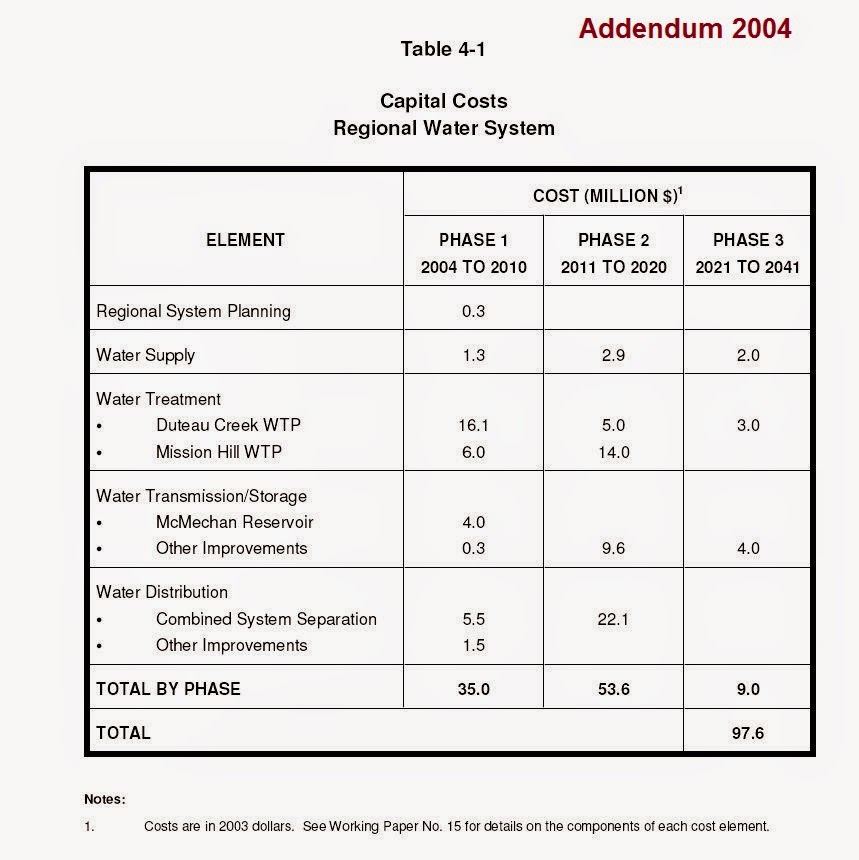
The other interesting part of the question is that it keeps referring to Phase 1. Below is a table from the 2004 Addendum identifying the various phases of the Master Water Plan. According to that table the current phase is Phase 2. Oh well, who is counting?


Note also the estimated costs: $35 M phase 1 + $53.60 M phase 2 total of $88.6 . Reality if the referendum is approved: $66 M plus $70 M = $136 M. The next phase, whatever that is called, will require a currently estimated $41 M more. Grand total barring additional unexpected costs: $177 M, a tidy some for irrigating agricultural crops.


 ***********************************************************************************************

Sunday, September 21, 2014

Unsolicited comments for the Borrowing Referendum.

As mentioned before my opinion is that borrowed funds for water infrastructure costs should be repaid through general taxation just like any other infrastructure loan. It is more justifiable to use taxation for water infrastructure than it is to use it for ice rinks or performing art centres because our homes water infrastructure is directly connected to municipal infrastructure unlike he above mentioned facilities.

In 2004 the majority of taxpayers approved the borrowing of $35 million. The annual cost of servicing that loan is about $2.45 million or a mill rate of about 0.25. A property worth $400,000 would pay a tax of  $125 annually. 

Did you know that to impose a tax of $399.20 your property would have to be worth about $1,600,000?

Why do I say it is a tax? It's because the $399.20 base fee (tax)  is not related to either unit cost of water nor to property value. You pay it regardless of what your property value is or how much water you consume, if any.

This is a unique idea of a user pay system where one user pays $104.80 for 10 cubic meters of water for a unit cost of $10.48 while another pays $242.30 for 100 cubic meters for a unit cost of $2.42. At the same time we are encouraging customers to lower their usage so they would get a bonus of further rate increases.

Industrial, Commercial and Institutional customers also pay the base fee but only pay $1.50 per cubic meter even though their water fees are part of doing business and are tax deductible. 

Furthermore grazing lands, hay fields, fruit and other crops enjoy the same quality water with less restriction than domestic customers and at a fraction of the price at about $0.07 per cubic meters.


This is another reason to support the $70 million borrowing referendum. We will have the pleasure of paying even more unfair water rates in the future!


*******************************************************

Tuesday, September 9, 2014

Councillor Spier's review of the borrowing referendum.

How is the Water Increase of 30% over 5 years explained ???

IMPACT OF VOTE ON RATES

  1. 7How will borrowing $70 Million for the Master Water PLan (MWP) priority projects impact water rates?
A “Yes Vote” would mean that the total GVW budget would increase by 30% for debt servicing (principle + interest payments).  This increase would be phased in over 5 years. This is based conservatively on a 4% interest rate and a 20 year borrowing term through the Municipal Finance Authority. The following provides an estimate of the impact to rates based on an average domestic GVW customer:
  • Average GVW Domestic Customer Water Bill in 2014: $585/year (based on 175 cubic meters of water used in one year)
  • Percentage Increase: 30% phased in over five years averaging 6% per year
  • Annual Increase to Water Bill: $36.00
  • Increase to Water Bill by 2019:  $180 (total annual bill in 2019 = $765)
It should be noted that this increase is only to fund the MWP priority projects and does not include additional increases due to the Consumer Price Index (CPI), increases in operations and maintenance, costs associated with any legislative changes, or other capital works projects required outside of the MWP (e.g. emergency repairs or infrastructure renewal). This projected increase for the MWP priority projects is for project construction costs in 2012 dollars using the 2014 rate structure for domestic customers (Greater Vernon Water Rates (Bylaw No. 2622, 2014).  
A “No Vote” would mean that the projects outlined in the MWP will not proceed as presented. The impact on rates is unknown and would only be determined following a review of the MWP with elected officials and Interior Health.
---------------------------------------------------
Don Quixote Note:
If we borrowed $70,000,000 for the Master Water Plan Capital Requirements this is the repayment schedule we would have for a 20 year borrowing at the RDNO predicted conservative lending rate of 4.00%. http://mfa.bc.ca/long-term-lending-rates (This chart is for comparative purposes only as rate are only guaranteed for the first 10 years.)

The Annual Financing Costs would be $5,150,722.
For 2014 the revenue required from rates was $18,600,840.
Of this $16,968,524 was to come from Domestic (Residential) ($14,224,499) and Commercial & Institutional. ($2,744,025) Balance from Agriculture was ($1,025,616) with other fees and charges bringing in ($606,700.)

Consequently the revenue required after this borrowing (if approved) would increase to $23,751,562 or a further 27.69% rates increase. (assuming rate increase spread equally over Agricultural, Residential , Commercial and fees)

However it appears that the rate increases will be applied only to the $16,968,524 For Residential,Commercial & Institutional and thus the %age increase will be (16,968,524 +5,150,722)/ 16,968,524 = 30.35%  (click here for more)
---------------------------------------------------------------------------------------------------------
The cost implications are bad enough but the worst news is the fact that we continue to treat the worst quality and most expensive to treat water forever. 

The combined cost of the two treatment plants at Duteau will be over $55 million ($3.9 million annual cost for 20 years). The annual treatment costs will amount to about $2.5-3 million. And to boot 80-90% of the treated water will be used for agricultural irrigation. 

Domestic use (includes household, industrial, commercial and institutional) from  the Duteau treatment plant only accounted for less than 1,500,000 cubic meters in 2012. Cost of treatment in the same year was over $2.2 million. Estimated cost of 1cubic meter of domestic water from Duteau is $1.44. At the same time the Mission Hill treatment plant produced about 4,300,000 cubic meters of domestic use water at a cost of $524,275 for a unit cost of $0.12. Somewhat of a difference. The filtration will add more costs. So now you have more of the facts to help make up your mind.

***************************************************************************************************** 
 

Coldstream Ratepayers News! All Coldstream residents are ratepayers!

The opinions expressed by "Coldstreamer" are strictly his own and do not represent the opinions of Coldstream Council!

Because I value your thoughtful opinions, I encourage you to add a comment to this discussion. Don't be offended if I edit your comments for clarity or to keep out questionable matters, however, and I may even delete off-topic comments.

Gyula Kiss
coldstreamer@shaw.ca;

***Coldstreamernews***

***Coldstreamernews***
We must protect our rights and freedom! (Photo courtesy of D. Gibson) Click on eagle to watch EAGLECAMS

About Me

My photo
I have been a resident of Coldstream since 1976. I have had 15 years of experience on Council, 3 years as Mayor. As a current Councillor I am working to achieve fair water and sewer rates and to ensure that taxpayers get fair treatment. The current direction regarding water supply is unsustainable and I am doing all I can to get the most cost effective water supply possible.